Friday, December 20, 2013

February 1, 1939: Philosophy 101


Translation:
                                Amstelveen, Feb. 1, 1939


Dear Anni, dear Gis,
 

Thank you very much for you letter. I want to go into something a bit closer. You thought of an ideal as the imagination of a goal, something that lies in the future, and you are convinced that this ideal in life shouldn't be taken from you. I believe that as well, but the question that I meant was: where is that ideal coming from? Surely it isn't anything you are born into, but something that developed as time went on. That is why I think that life is creating ideals, because according to other life circumstances and with other life experiences the life ideal would look differently. 

The people you are talking about, of which you Anni are writing that they are dull and content, they aren't like that because they built their ideals in accordance to their lives, but because they don't have any ideals at all. Whoever wants to create higher ideals, can only do it out of life. Let's take for example the idea of a kingdom of God on earth. It is based on the belief of the good in humans. Where is this belief coming from? Out of the tiny part of experiences one has made with a few people, and with a few people one knows and has heard about, and even then, one has to sometimes wait a long time until something can be discovered that could be considered good in people. Who guaranties then, that one never finds a person, or a majority of people who have nothing good to show for? I do believe also that there is good in human beings, I cannot know though, if I won't be convinced of the opposite one day. And if the opposite convinces me and the opposite proof is obvious, then the faith will have to fall too. It hasn't fallen yet, of course, I only want to say with that, that examination stands above the faith, and that a faith that stands in opposition with the mind and reason, cannot hold up. But is it most often so, that faith and reason can exist very well next to each other, that they run parallel to each other and have nothing to do with each other, so that no contradiction develops. But one shouldn't give faith a higher role. 

Anni, I can understand very well that you want to break free of the stuff with which you have been raised with, but I don't know if this would be possible alone with the fact that you are in contact with other thinking people. You have the beautiful, but also dangerous gift of amazing rhetoric, which is very helpful during a discussion, which results that you easily come out as the winner through words, without having convinced anyone, and anyways when discussing, one doesn't start with the standpoint of: What will hold up of my opinion, but rather: How will it be possible to convince the other. Only that way will you be able to make yourself independent, by checking if what you have been taught, if the Quaker thought is in congruence with your mentality, if it seems to fit and if it can satisfy your most inner being. Or if you have to bump into opposition, but check it not only of the point of view that the Quaker thought is the only true one, which you have to defend under all circumstances, but make sure to check objectively, or at least in as much subjectivity that you see yourself as the primary thing. 

I have been talking to a person here, who has called himself an anarchist, which the anarchists have unjustly gotten a bad rap. I told him many hours about the Quakers, of their faith and work, and when I was finished, he gave me this answer:  "That is also a way of expression, maybe even a very good one." He showed me the same ideas and the same spiritual powers , available in all kinds of different religions and worldly opinions, yes even in the atheist ideas, he showed me how things are done better in such and such a thing or in some things worse, how a problem was solved a different way etc. And even if I don't agree with him in all points, I did see that often the fight is all about words, and how really a world view is often only a matter how it is formulated.
 

My French Visa still hasn't arrived, in spite of all kinds of connections. But I have hope again to come to America. I wrote to Mr. Martin, he now gave me an answer through the American Friends Service Committee, and he made me big promises. It should be very well possible that I could get an admission certificate for one of the universities from over there, and since the study visa is a non- quota type, it should go fairly fast. I shall send in my resume, photo etc. and someone will get connected with the concerning places. Well, I am not very optimistic at this time, but still these are hopes again. I also have received a very good list of the requirements for the study course, the costs, and possible offers after the study. It seems afterwards the possibilities seem really very good.
 

Gis unfortunately I have to disappoint you about the job with the English family. The position has been taken last week. It probably wouldn't have been anything for you anyways, since the people don't have any children. They promised me however that they would keep their eyes open for something fitting for you. Please write me quickly and let me know if it has to be a paid position.
How far are you now with your Australian affair? Do you have any specific possibilities over there?
 

Please greet also your parents, Kaethe and Reinhard.
 

With hearty greetings,
Tom.


If I ever needed affirmation about my decision to choose Philosophy for my undergraduate degree, I need only look at this fantastic letter. Opa the Philosopher. I wish we had been able to have these kinds of conversations. This letter is reminiscent of my early college days when I had the freedom to think, question, discern, decide. I went deeper than most of my friends, and when I found my friends in the philosophy major, I found kindred spirits. Opa has kindred spirits with the Quakers. Even in his autobiography, he writes about how the Quakers met his need for intellectual conversation: 
I got restless for some intellectual (spiritual?) activity. Through a friend, I was introduced to a Quaker "Young Friends" group that met monthly. (p 4)
Opa is writing to Anni and Gisela, the Halle sisters that he connected with in the Quaker youth group (Young Friends). You can tell that he has an intellectual thread continuing with Anni and a more practical friendship with Gisela. It’s fascinating to see the difference in his relationship with the two of them, as it matches the differences in the sister’s personalities.


Anni has always been a bit of a debater, and Opa is up to the task. I kind of want to engage in the debate if you’ll humor me. It sounds like Opa and Anni are debating the basic foundation of thought: where do ideals, or the basic premise of faith-thoughts, come from? And what is the measure of a sustainable ideal? Anni seems to be struggling with the Quaker ideals, trying to find her way in them, and bored or frustrated by the apathy of others who do not explore further. However, (and this is so Anni)- she seems to have a clear idea of what she thinks and knows and believes, and will defend that to the ends of the earth.


Opa argues that faith or ideals or goals, however you want to put it, grows out of our life experiences. That the belief in the basic goodness of humans will grow out of an experience of human goodness. Opa’s premise is that faith and reason (an outgrowth of experience) should coincide. He makes it a special point to say that in this relationship, “one shouldn’t give faith a higher role.”


Then, and I love this part, Opa pretty much calls Anni out on her impossible rhetoric. I experienced this when I met Anni in the sitting room of her historic home that lies just outside the hustle and bustle of Berlin, Germany. Anni left very little room for conversation and debate, and rather had a lot she wanted to tell us. Her refrain was that we should only “speak of facts.” And she spoke her facts for nearly three hours. It was one of the most fascinating conversations that I ever had, and I hardly spoke a word. She had a formidable presence, commanding your attention and respect. I can see what Opa is saying here, that she has the “beautiful, but also dangerous gift of amazing rhetoric…”


Opa challenges Anni to slow her rhetoric a bit and sit down with the ideas and experiences, and reason it out for herself, in as objective a way as possible, giving all ideas fair play. Opa gives his experience with an anarchist as an example. He enjoyed his conversation with the man, because he was able to connect and find common ground, although it was not to say he completely agreed with everything the man said. Opa found the intriguing part in the anarchist’s claims, and gained a new perspective on this otherwise ignored viewpoint.


I can’t help but think of the parallels in Opa’s world and mine today. Opa was surrounded by conflicting theories and political ideologues. Germany was especially rampant with warring political parties:
 ...a plethora of political parties abounded, all the way from communists to the far right movements, including such demagogues as Adolf Hitler... I remember many incidents of street fights, even riots, when we were warned to stay home; these fights were between primarily three dominant political parties: the Nazis, the "Nationalists," and the Communists. (p 2)
Each party resorted to violence and manipulation to gain followers or perhaps better put: subjects. This played itself out negatively as the most powerful, manipulative, and violent party won: Hitler’s Nazism. People lost the ability to have conversation and absorb the valid points of the other. This polarization resulted in what we study as the second World War.


The reason I studied philosophy, and still enjoy it today, is because in some ways, I believe it can be the fair playing field where all voices are heard and the good and the bad are sorted through the frames of logic, experience, and instinct. Philosophy demands that you think, and that you listen. Philosophy gives a space for me to play out my ideals and those of others and see if, when I lay it all out, it holds up under scrutiny. When Opa suggests that Anni combine her experiences, reason, and the thoughts and ideas of others- what he is basically promoting is Philosophy 101. Think about it. Think about how you think, and why. In the end we may find that much of what separates us from them is semantics, or procedure. Like Opa said “I did see that often the fight is all about words, and how really a world view is often only a matter how it is formulated.”


In my world today, this same polarization is happening. We are again losing the ability to have conversations about things we care about without resorting to powerful rhetoric to win the argument. The goal should not be to win, but to learn. I have to check myself on this all the time. A couple of men came into the car repair place where I am typing this. They are both armed, and my gut instinct was recoil, and disgust. I don’t like guns. However, I watched them sit with an elderly man (a father? Grandfather? Neighbor?) and listen to his stories with utmost respect and kindness. This experience checked my prejudice. It showed me that even if they had been obnoxious and stereotypical, they still possess the kindness and goodness that is required to listen to an old man tell stories.


It teaches me (once again) that you don’t have to agree with everything a person says or does to respect or connect with them. You might even learn something. Opa learned this lesson, and I think his life experience shaped that ideal. He had wisdom in seeking out truth, not through extremes of rhetoric, but through careful reasoning and relationships with people who were not just like him.


Lastly, Opa mentions his dashed hopes for a French Visa, which he seemed sure to receive. And now there is the dangling carrot of hope from America through his friend Mr. Martin.


Gisela is also looking frantically for a way out, it seems. Unfortunately the job Opa found is no longer available, but he promises to keep an eye out. Also, the Halle family seem to be looking elsewhere for options: Australia!


So today, after reading this long introduction to Philosophy… I want you to engage in conversation with someone who is not like you. And listen. And think. That will be your day’s contribution to world peace.

Tuesday, December 3, 2013

January 15, 1939: Shenanigans


Original Letter from Opa (Tom) to Gis (Gisela)

Translation:

Amstelveen, Jan. 15th, 1939

Dear Gis,

Many thanks for your letter.  You will hear from Anni, what I meant to say in my last letter, so I don’t have to write about it again.  The fate of the Young Quakers seems quite hopeless.  Whatever happened to the 10 persons Mr. W. had promised?  Perhaps it is good that your group will dissolve, because judging by your description, it does not seem to be an all Quaker group anymore.  Looking back, the Pyrmont trip pushes back into one’s memory.  As a matter of fact, that kind of party would have been possible then already.  Do you remember with what enthusiasm popular hit songs were  screamed (sung) loudly, how difficult  it was to have an intelligent discussion with them, how there was laughter during prayer time, back then one accounted that to youthfully light spirits, now it seems to me, it was the preparation for that New Year’s celebration.  What does Mr. W. say about all of that?  It must be especially bad for him to see this as the fruit of his work.

Great that you enjoy your work.  If you are still looking for a British family, write to me, I know somebody who would love to have you.  So write soon, before the position is filled otherwise.
Write also, how long you will stay there.  

In the matter of my Visa, I am close to despair.  In P. (Paris maybe?) my sister contacted an attorney who went to the ministerium, where it showed that the file was not to be found.  Who knows how long all this will take now?  In the meantime, I initiated  something in America, but the Americans are not much in a hurry either.  So not to waste time here, I attend studies in Math at the university, however not enrolled, which means I cannot take exams, and that my studies will not be credited anywhere.  But it is still better than nothing.

How are all the others of the group?  How is Theo? How is Herbert, is Manuel still with you?

I thank Kaethe for her greeting, please say hello to her from me.  Until a Wiedersehen (see you again) at your trip to England.

Tom
 
This is the Quaker House in Bad Pyrmont, Germany. A place of retreat for the Berlin Quakers.


I'm back to the letters from my Opa that Gisela saved for some 70 years. We paused to do some highlights on events and folks mentioned, but now we're back to the letters. This one continues the New Year's Eve party discussion...

Opaʼs letter to Gis (Gisela Halle) on the same day as her sister (likely in the same envelope) addresses the other part of what seems to have been their letter to him. He addressed the changing landscape of his mind and opinions to Anni. Now to Gis he discusses the disappointing New Yearʼs party and the failing Quaker youth group. After reading his letter, I have to admit, I giggled a little bit. Seems like Opa is 19 going on 47. Heʼs got a “those youngʼuns” kind of tone through out the letter, like he just canʼt believe a group of teenagers would run around yelling and giggling at inappropriate times. Ha!

Honestly though, I can imagine how hard it was for a group that was so close and formative in each otherʼs lives to experience the inevitable falling away. The group has lost many of its leaders to the world events and just basic age: people are moving away, finding careers, and in light of Germanyʼs political climate- many are moving farther away and sooner than might be anticipated. The diaspora of Germany and Europe is being felt... even on the smallest scale of a group of kids who got together for moral, spiritual, and intellectual support... and above all- friendship. Those ties are being tested by the whirlwinds that confuse, toss, and disperse.

In order to defend the ancient sound of my Opa at the age of 19, I do need to clarify something about Quaker practices. The screamed songs and giggling prayers... really would have stood out significantly more in a Quaker setting than perhaps a different type of atmosphere- religious or otherwise. Especially German Quakers. German culture is not loud, brusque, or flamboyant. At least not my interaction with it. In restaurants, you can be in a completely full place and carry on a conversation in a normal voice- and hear each other! This is not the case in the US. When I flew back to the US from 10 days in Germany, I sat in the Atlanta airport and I thought my head was going to explode. The TVs were blaring, everyone seemed to be yelling, it was just excruciatingly loud. Iʼve adjusted of course, but this gives you an idea of how culturally quieter Germany is. 

Now, add to that culture the practice of the Quakers. The Quakers spend their worship in silence. Silence. One glorious hour of silence. And they are all completely comfortable with it. It is a very sacred time and moment- it is not stifled, foreboding silence, but peaceful quiet. The silence is not confining, but rather peacefully freeing. The popular song that the youth group sang, “Die Gedanken sind Frei” (Our Thoughts Are Free) is about facing censorship with the hope and dignity of the fact that our thoughts cannot be confined. The inner life for Quakers is an extremely sacred and life-giving thing. Practicing silence in a group is strangely communal. I never really understood how being quiet with a group of people could be a communal event, but it is wildly so. That communal moment has as its foundation a mutual respect of the silent, open space to connect with the Spirit that speaks into each soul. That silence is the open space out of which someone may speak if they feel the Spirit has spoken something to them worth sharing. That silence is an equalizer. So it makes a little more sense that the screamed songs and giggling in that sacred silence was so offending... Not to say that it is so incredibly surprising, but perhaps it is more surprising and disrespectful than another setting.

Opa moves on from the “wild” party and asks about Gisʼ work and possibility to move to Britain. I am quite confused about who he would know in Britain to connect her with.

Opa writes about his Visa - and it is interesting that he had a real plan (plan B?) to go to Paris. What would that have been like? What would he have done? If he ended up near his sister.. how drastically that would have changed his life! It seems that his Visa in France was delayed primarily because it got buried in the pile.. It just really boggles my mind to think of how completely different his life would have been if he had gotten a Visa for France... Thereʼs no way he fully comprehended the wildly different paths his life would have taken depending on where he went. He really was just functioning in the present, trying to get himself to the next step, next available possibility- anywhere. Study in America, study in France... just anywhere but Germany. I love that he filled his time attending classes- just for fun. Not literature or something, math classes. Thatʼs the nerdy Opa I know.

Monday, December 2, 2013

Spotlight: Bern Brent


Here I am with Gisela and Bern. Bern is wearing a backpack- because when I'm 91 years old, I pray that I will be rocking a backpack while running around the city of Berlin. LOVE him.

Bern Brent, or “Gerd” Bernstein as he was known to Opa, is a dear man who has lived a fascinating life. I keep starting this blog entry and stopping, because I am so endeared to this man that I don’t know if I will say everything I want to say. Let me just be honest and say: I really wholeheartedly love this man. Bern is 91 years old, he emails with me regularly, responding to my questions about his life and his time with Opa in the Quaker youth group.  He and my Opa were friends in the youth group, although not as close as Opa was to the Halle girls and other of the older youth group members. Bern is about two years younger than Opa. When I traveled to Berlin last summer, Bern was there on a month-long trip to see friends and family. He lives in Australia, where he has lived since 1940. This is not your normal 91 year old.


When we first learned about Bern, we knew he was one of the members of the youth group. Anytime you learn someone’s name the first thing you do is google them, right? Well our google search led us to one particular chapter in Bern’s life, and it wasn’t the Quaker youth group. Bern was one of the Dunera boys. I need to back up a bit to explain how Bern became one of the Dunera boys (and I’ll explain who those boys were).


Bern was together with Opa in the Quaker youth group- his experience was very similar to Opa’s. Bern came from a family that had Jewish roots but not necessarily Jewish practices. His parents were also divorced, and much in the same secret and quiet way that Opa’s parents were. They shared a lot in common, actually, and I’m sure this didn’t escape them as they chatted with each other in the group. Hitler’s rise to power in Germany created a political and social situation that was a catalyst for a diaspora of religious and political refugees. Opa and Bern were among those caught up in the web of flight. You have been following Opa’s journey to the US. Bern’s story took a very different path. After kristallnacht, the kindertransport (see previous spotlight) was organized in an effort to get vulnerable groups, primarily children of jewish descent, to safety in Britain. The effort saved many lives, Bern’s being one of them. The first kindertransport left Germany on December 4th, 1938. Bern was on the train December 14th, 1938- he was 15 years old. He traveled on the transport to stay in England. Here are some snippets from his memoir “My Berlin Suitcase” about that experience:
I learned about the kindertransports by chance. Daisy (a Quaker friend) recorded the occasion in an unpublished article:
Monday evening (after a Quaker meeting)...Gerd said “I left my raincoat behind. I’ll pick it up tomorrow.” One Tuesday morning the phone rang. “It’s Gerd. I’m in the Quaker Bureau...it’s quite chaotic here… they are registering children for transports to… England.. hurry up… come along… get registered… I’ll wait for you here.”
When I entered the Quaker Bureau on Tuesday morning I found myself in a veritable beehive. I learned of the Quaker initiative (kindertransport) from someone there, rang home immediately to ask for their views, put my name on a list for Britain, and rang Daisy. The following day my mother telephoned Frau Halle, Gisela and Anni’s mother. Frau Halle was then Clerk of the German Meeting, the chief representative of the Quakers in Germany… My mother asked her if it was possible to include me as soon as possible in any of the transports to England. Frau Halle said “Yes, of course, no problem.”

Now over sixty years later, I realise what a momentous decision it must have been for my parents to send me off to foreign parts on my own. I now know that many parents could not do so and decreed that the family stick together, come what may. At the time nobody had the slightest inkling of what lay ahead. I was an incurable optimist even then. To be temporarily separated from my parents was no great wrench. I had been away from home many times…

On the morning of 14 December 1938, Omama and Mum and Dad took a taxi with me to Charlottenburg Station.. I would catch the special train there that was to take me abroad… I have since been asked if I was upset  and crying. I was not. I was not omniscient. I had no premonitions. I was excited at the prospect of living in a strange country and looked forward to the adventures awaiting me. My folks put on cheerful faces. I never doubted that I would see my parents again. I did. Many children did not. The train slowly pulled out of the Charlottenburg Station gathering speed. I leant out of the window to wave to Mama and Papa and Omama who waved in return. As they grew smaller and smaller, I lost sight of them and settled in the compartment. My childhood was now behind me and a new life began.

I think you might be getting an idea of why I love this man so much.

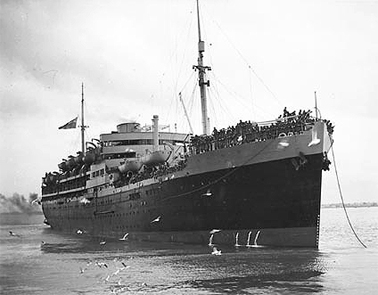
Bern’s adventures were no over.  In 1940, the Germans invaded Holland and moved through to France with astounding speed, a blitzkrieg. Germany’s invasion, and the speed with which it carved out a large chunk of Europe for itself, was surprisingly successful. A whiplashed Europe could think of no other explanation but to assume there were spies underground. This conspiracy theory was referred to as the “5th Column.” The “5th column” is a term used in reference to a small, secretive group of people who function to rebel within a larger group or stage a coup, etc. So- spies. Then Britain did something monumentally stupid (which they admitted later). They decided to ship (as in put on a boat) all the “5th column” suspects to be interned in a remote location in Australia. These “suspects” included prisoners of war and Nazi sympathizers, but the majority of this shipment were Jewish refugees, to include the children 16 and older from the kindertransport. All on the same boat for the Australian bush. Really bad idea. Awful, bad idea. The infamous Dunera ship was horribly overcrowded, stealing was a common occurrence, and most of the ship’s staff was later court martialed for their harsh treatment of the ship’s occupants.

'HMT Dunera', Melbourne, 1940. Courtesy National Archives of Australia

HMT Dunera, Melbourne, 1940. Courtesy National Archives of Australia

Bern was on that ship, and would be later lumped into a group called the “Dunera Boys.” He was without family, about 17 years old, and being shipped around the world on a boat that had about twice its capacity. It also happened to be torpedoed twice, unsuccessfully. I asked him about this experience as he hadn’t really mentioned it much in his memoirs or his conversations with me. Most outside accounts of this trip are quite gruesome. This is what he said:

Regarding the Dunera.  To be interned in June 1940, aged 17, and sent to Australia, where I was behind barbed wire for another 16 months, was the best thing that could have happened to me at the time. Better than winning whatever lottery was going in Britain at the time.
Firstly I was able to catch up on my education.  Tom (my Opa) emigrated with his Abitur - and any Australian university recognised the Abitur as a sufficient qualification for university entry provided there was proof of English language ability.  I had left school three years before the Abitur.  During internment I was able to prepare for the requisite Australian matriculation examinations.  Some of them I sat for in internment.  Others I passed before the war finished.
Secondly, I learned more about people and the world around me during one year's internment than during any year of my life, including my university years.
Thirdly, had I remained in Britain, I would have undoubtedly joined the British army and, unlike Tom when he joined the U.S. Army, I had nothing to offer but a pair of hands.  They would undoubtedly put me into the infantry and I would have put up my hand in due course for 'special services'.  I don't give myself more than 50:50 to have survived the war.
But even if I had survived, what would my future have been?  I have no idea.  But I have no doubt that I did very much better in Australia than I would have in Britain.

This is the perspective of a man who has had 90+ years to reflect. It’s kind of amazing. I am humbled by his natural optimism. This is not an untested spirit, it is not a modified response, this is an honest and straight-forward reflection. The thing that impresses me about Bern is that he is completely comfortable and rested in his own skin. There is no show about him. We shared drinks and a meal one night in Berlin with his family and my Dad was tricked out of paying at least for our portion of the tab… My Dad “chastised” him about this the next day when we gathered, and Bern was so simple and frank with his reasoning. He said “When you get to be 90 years old and you are like me, money really isn’t something you worry about.”

That is Bern. His perspective of the world is frank, real, and yet also optimistic. He does not worry or fret about things beyond his control, and he squeezes the good out of every circumstance that he experiences. I’m not sure if he was always this way- but I am grateful for his story and his perspective today. I told him I was doing a little spotlight on him for my blog and wanted more information about his Dunera experience. He sent me a email that included the quote I shared you, but also he sent me links to some work that he had done in retirement. This link HERE is to his book reviews that he did for a publication in Australia. If you want to be impressed, humbled, and even get some laughs- check the link out.  Look especially at the review he does on a book that covered the Dunera Boys. It’s pretty fantastic.

This is just a spotlight on parts of Bern’s life, and hopefully more about his personality. The most compelling discoveries in retracing my Opa’s life- are the people he befriended. In this discovery, I am learning that Opa was surrounded by incredible people with big hearts. I have also learned that there are many many people like this. How lucky I am to meet some ordinary folks who embrace life in extraordinary ways. Bern Brent is the kind of person everyone should have a glass of wine or coffee with… that’s why I keep encouraging folks to go out there- and look for your Bern. Look for your unexpected inspiration.

Tuesday, November 19, 2013

Spotlight: Kindertransport


Spotlight on Kindertransport

So far, we have given a couple spotlights on people. We also wanted to give easy ways for those reading the blog to engage significant events that may not be well known to everyone reading. The kindertransports are one of them. Opa mentions while in Holland the opportunity to see people as they are coming through to England. Most of these folks he is talking about are part of the kindertransports. After Kristallnacht, it became a priority for many German parents, particularly Jewish parents, to get their children out of danger.
England agreed to accept children refugees, so from Dec 2, 1938 to September 1939, these “children transports” became known as kindertransports. Sarah, when she went to Germany, visited the monument with Gisela and Bern. When Opa mentions not seeing Gerd when he came through, he was talking about Bern. Bern was on one of the first kindertransports (Dec 14, 1939). Other friends and acquaintances of Opas were on Kindertransport. Below is Sarah’s reflection on seeing the powerful monument to these transports and a link to learn more about them:

When my parents and I met up with Gisela and Bern at the Quaker meeting house in Berlin, we had an idea of what to expect. I expected pictures, stories, letters, and a tour of the meeting house. What I got was infinitely more. Gisela and Bern dialogued, remembered, and shared. I could listen to the audio countless times while gleaning more information and nuances each time. Little did we know that Gisela’s plans for us that day expanded beyond the little meeting house. This is appropriate, because the Quaker lives never stayed isolated and insulated in the Quaker meeting house. They ventured out into the world and worked for justice and peace. Gis walked us outside and towards a train station. I thought we were just catching a train to go somewhere. We rounded a corner and I saw this:


This memorial is called “Trains to Life, Trains to Death.” It held in stark contrast the images of children leaving on the kindertransport for England and children leaving on the rail cars for concentration camps. I stood there, half-listening to Gisela talk about the memorial, but distracted by my observations of the characters in stone, the people passing by the memorial, and Bern. Bern had never seen it before. I understand more now than I did then what that memorial might have meant to him. I still don’t understand more than a fraction of what he must have been thinking about, remembering. At the time, I wanted to announce to the street that this man had been on the kindertransport- out of pride to be connected to this moment in history. But the people walking by, they see it every day. Their great aunt or friend’s uncle’s mom had something to do with it.  It’s like how we treat cancer... we all know someone who has been affected by it, almost to the point that we are numbed to it- but the closer it strikes, the more surprised we are. 

The kindertransport was a powerful and desperate act of kindness out of the faith we have in the innocence of children. If we cannot do anything else, we must at least spare the children. On one side of the memorial, you saw well-dressed children with suitcases and little tags on their clothing. Bern said that they all had those tags as identification. The children had brave expressions of hope on their faces. On the other side of the memorial, facing the opposite direction, you saw children in shabby clothes, with a darker tone to the stone. They all wore the star of David and their dilapidated suitcases were flung in a pile behind them, discarded. Their eyes were vacant, downcast, with maybe a flicker of fear. They were the ones destined for almost certain death.

I heard Gisela explaining the symbolism of the various images and the distinctiveness of the two “trains” going to either life or death... and while she was speaking I saw something that made me hold my breath for a moment. Two little girls, both happy in spirit with blonde hair like halos around their heads, climbed up onto the memorial. Their parents were casually watching them as they talked amongst themselves. The girls were on each side of the memorial, touching the head and arm of the stone figures. The girls were nearly identical in size to the children in stone. Something melted inside me, the stone became flesh and the girls showed me right there who was on those trains. And just as arbitrary as they chose the side to inspect the statues, that is how arbitrary was the outcome of who would live and die. 


I looked at Bern and thought about how much of a miracle it was that he was standing there... miracle upon miracle really. How blessed was I to encounter this man... 

We were just walking around Berlin to get to the train when Gisela had us stumbling over one of the most memorable memorials of the city. I didn’t know much about the kindertransport- and though I know much more now, I realize how little I know about that page in history. 


Here are two good links with good info on these life-saving transports:


Sunday, November 17, 2013

January 15, 1939: Life is Primary

Original letter from Opa to Anni

Translated by Rose

Amstelveen, January 15th, 1939

Dear Anni,

I believe you misunderstood me in my last letter, perhaps I did not express myself correctly.
Yes, I have changed my view (opinion), but that does not mean that I now approve what has been feasible since 1917.  The problem is not that easy (simple).
From a very young age you were raised in the Quaker Spirit (beliefs), learned about other ideas only in theory, have never associated with other circles so you could see and learn. At home you always had strong support, and a buildup of these ideas, have been lucky that those ideals you were raised on gave you that inner satisfaction.  Any doubts about those ideals you were able to quickly suppress, because of that support.
All that is beautiful, and I envy you for it.  But you don’t seem to know, what it means to gain a worldview by yourself, how many disappointments and change one has to go through, and how at the end one is afraid to be subjected to the influence of a specific circle, since one has many circles and could take only a bit from each one.  You judge people based on their view of the world and the closer they are to your view, the better a person he is.

The saying: Grow into your ideals, so life cannot take them from you, is wrong because life is primary, life builds ideals, if they are real (true), one builds them from experiences with people, the story and one’s own fate.  One must have studied other  ideas very closely, had to have a solid opinion about it, which again can only be founded by life experiences, and even when one grows old, to 100 years, one has not gathered enough experiences, cannot study enough to be able to say: This is my opinion.  How little can we with our not even 20 years know about life?  I cannot believe strongly  in an existence in such a far future, which now only exists in my  hope, which keeps me from criticizing the present.  Whoever can do that can count himself lucky, I cannot do that.
Naturally I am in contact with the Friends here.  Every 14 days I am in Haarlem at a meeting, have contact with the J.F. (I guess that’s Jung Freunde, young friends) here, and I am with all of you in my thoughts.  And I have no intentions to reduce my tie to the Friends  in any way, but I want to shape my beliefs independently from a one-sided influence.  So you will understand, what I meant in my letter.
I was also somewhat surprised about the planned New Year’s party.  I never expected anything different from Hans, but that Eva and Guenther were influenced like that, I am sorry to hear.  Whenever anybody goes to England and comes through Amsterdam or the Haag, let me know, I am in the Haag more often, but Rotterdam, where I could have met Gerd, is a bit too far and the Dutch Rail is outrageously expensive.
Your new subjects interest me much.  Will I get some notes of the discussions?
I hope to hear from you again soon.  Please say hello to your parents and the group.
With Friend’s greetings,                            
Tom


This letter to Anni makes me love Opa even more. I had to read it a few times to really collect all the good things that I loved about it. I’m not sure exactly what Opa has written in the last letter that Anni misunderstood. If it was the letter from November, this is my guess:

One might call the suggestive, one can call it the joining spirit, which lies over such a prayer meeting, one can also speak of imagination, it’s all the same, the feeling is present, perhaps just imagined, but it is beautiful in its’ present. As I said, it gave me a home feeling…

Perhaps the idea of the Spirit as “imagined” rubbed Anni the wrong way? Or perhaps it was something else entirely, but Anni must have responded in some way that showed she was upset at outside influences on Opa’s ideas. Opa admits that he has changed a bit through his experiences... His line “that does not mean that I now approve what has been feasible since 1917” - is a mystery to me. I’m not sure what he’s alluding to. 1917 is an important year, but many things were happening that Opa could be talking about. The first world war was coming to a close (WW1: 1914-1918), the Russian Revolution was erupting, America declared war on Germany in 1917 (I was surprised by this, for some reason I thought the USA was involved in the war longer).. but nothing that stood out to me as something specific that Opa could be referencing. He was born in 1920, so he can’t be talking about his own journey... what historical or societal thing is he mentioning? Any historians have an idea?

Whatever the debate is specifically about (if it is specific), Opa makes a beautiful case for learning as you live. The philosopher in me is enamored with these words. 

He starts by describing Anni’s situation, someone who was born and raised in the Quaker “Spirit” and exists comfortably in the supportive circle of Quaker thought and life. Her entire life is reinforced Quaker experience. He notes the beauty of it - how lovely it must be to be satisfied on the inside by the safe circle of influence. 

He then contrasts his experience, as a boy who grew up with agnostic (at best) parents, one who practiced some Jewish ritual but never participated in any faith community. His family life was not as stable as Anni’s - although Anni’s family life was a completely different set of struggles. (Her parents were leaders in the Quaker group and her great-Uncle was the famous German aviator, Otto Lilienthal.) Opa learned about his beliefs and opinions through a series of life experiences. His parents were divorced. Opa’s father was tied up in the newspaper business, his mother was an educator with an ear to the ground for more learning. Opa’s experiences in his education, through his parents, through the Quakers, through his own reading and exploration- these were all worthy contributors to his circle of influence. He was wise enough to see through the Hitler regime, he was vulnerable enough to seek friendship and intellectual growth through the Quakers, and yet he did not stop there. I think this is where he critiqued Anni. She stopped, and chastised anyone who moved outside of where her realm of thoughts and ideals were: “You judge people based on their view of the world and the closer they are to your view, the better a person he is.” I think many of us can be convicted by that statement.

My absolute favorite line is Opa’s rebuttal of the saying “Grow into your ideals, so life cannot take them from you...” Opa says it “is wrong because life is primary, life builds ideals, if they <ideals> are real (true), one builds them from experiences with people, the story and one’s own fate.”  I really hope he’s not quoting someone here, because if these are his words: wow. Life is the great teacher, and the greatest instructors in it are the people we interact with. 

In seminary, there was a running mantra, such that it was a joke almost. Kind of like “Jesus” is the answer to all your Sunday School questions, “It’s all about relationship” is the answer to all your seminary questions. We would throw this phrase around a bit, just because it really was an adequate answer for many debates. What was the most important thing? Relationship. Relationship with our fellow humans, relationship with nature, relationship with God. We could trace it all back to relationship. In a way, I think that Opa is saying this to Anni: relationships, people, experiences- these are all primary teachers. In any study or research you have primary documents... and the most primary of them all are people. The problem for many is that people are not cut and dry. People are not black and white. They are messy, nuanced, and too flexible. Opa, at least in this moment, seems to embrace the flexibility of life experiences. He seems to acknowledge that even if he felt completely sure of something today, he could not say with absolute certainty that in a lifetime of experiences he would not change his mind. It’s as if he is saying that to be so certain is to be closed to life’s primary teachers.

So he is not going to close the door on the worthy teachers from the Quaker tradition, but he will also not isolate himself from any others. He embraces the nuanced, messy, chaotic, and integral teacher for all things: life.

Apparently something weird happened at the New Year’s party- and he talks about it more in the letter to Gisela, written this same day. 

Opa seems to be a geographical stop on the way to England for folks riding on the kindertransport or other means of transportation out of Germany. He missed Gerd’s passing through- and that is too bad. I met Gerd last summer in Germany, he is now called Bern, and he was one of the first to ride the kindertransport to England. He ended up in Australia, and by chance he was traveling (at age 90) to Berlin when I was there with my parents. He is a fascinating person, and after this blog I will do a spotlight on him and the kindertransport. 

Opa is broadening his horizons with travel, new personal interactions, and more time to think. Little does he know how much he will see in his lifetime, and how life will continue to be primary as his greatest teacher.