Sunday, March 15, 2026

October 20, 1944: War is Hell, But I'm Fine


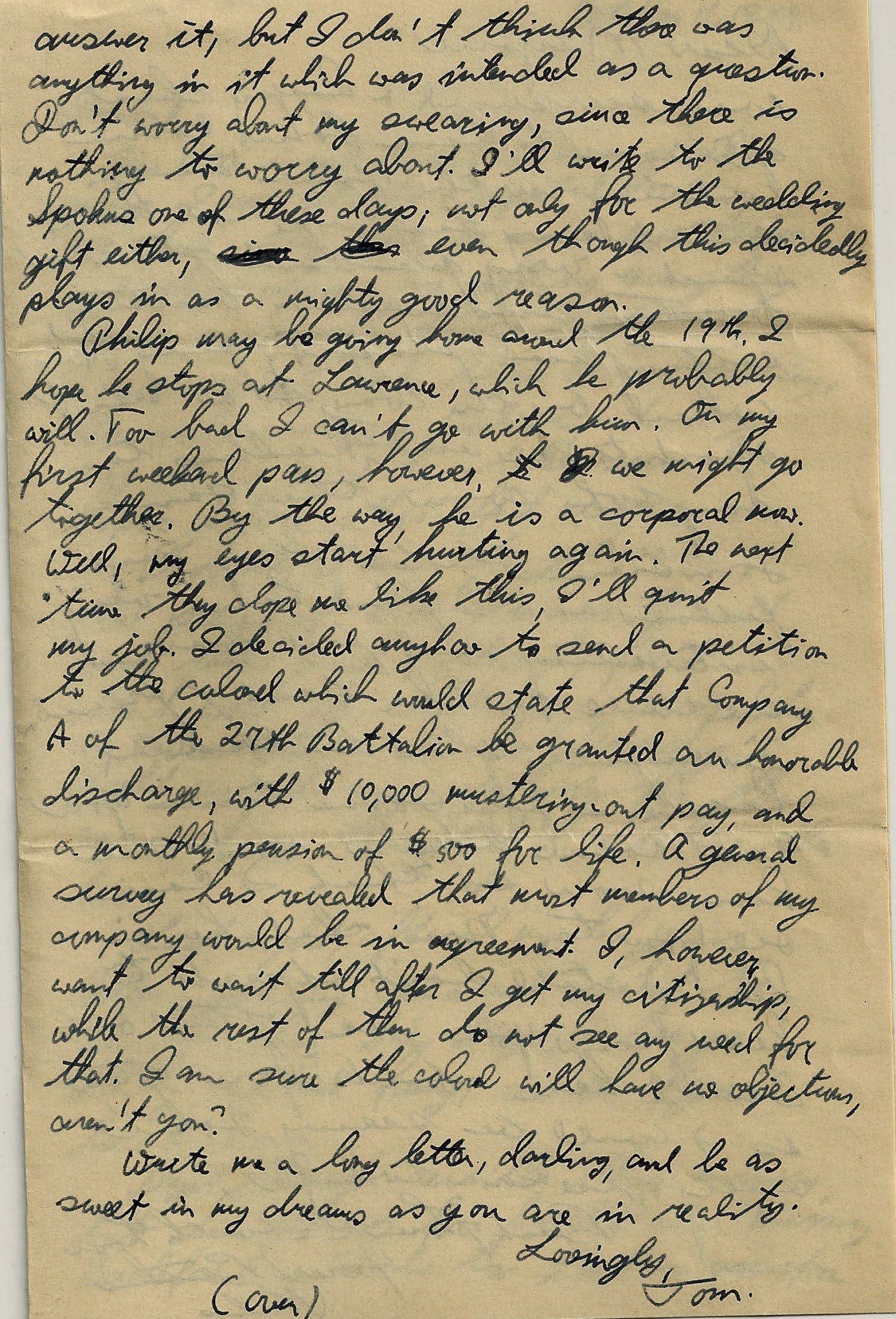
Letter from Opa to Grandmother October 20, 1944

October 20, 1944
My little Darling,

Today, I received two letters from you; one of them was written Wednesday and the other one on October 4; it had only now been forwarded from Leavenworth. In that letter, you wrote about the hard time you had getting back to Lawrence from Leavenworth. That was certainly too bad; you were lucky to get a hotel room at all in Leavenworth. I bet you didn't sleep much that night.

What is the "Milk of Magnesia?" Something you can't write about? By the way, remind me that I tell you two good stories next time I see you.

This has been another pretty hard day. According to some so-called authority, we are going to have our first parade tomorrow, so they really had us drilling. Personally, I don't believe in that parade yet, it may just have been a trick to get us to work a little harder. Nevertheless, we drilled for three hours in close formation with rides In my estimation, we look just like what we are: a pitiful bunch of ignorant rookies. (I hope we are so bad the decide to fire us.)

Also today, we saw two series of films, one was on sex hygiene. It was fair, not as good as some we have seen. The main purpose was to show us the proper use of various prophylactic kits; they illustrated how the rubber should be put on to prevent infection and similar stuff in which I would probably have been interested two or three years ago.

The other show was extremely gory and left absolutely nothing to the imagination: a show on First Aid. We saw jaws that had just been broken or shot off, with blood running out of the opening where formerly a mouth had been; chest holes, where the air went through at every breathing; belly holes, with guts sticking out four or five inches; legs lying one place, a stump of man several feet away, blood squirting out of the wound. There were two guys who passed out, just seeing the picture; several got sick. It didn't affect me in the least. I feel very sorry for these kids, for they are going to have a tough time when they will see these things first-handed on the battlefield. I only keep asking myself: why would they show us Signal Corps guys this kind of pictures, and give us this type of training, unless they planned to send us into combat zones?

Well, after these shows, we needed some relaxation; so, they first took us on a three-mile hike, part in double time, and then topped of the afternoon by an hour of extensive "physical conditioning." We dragged our bones home after having loaded our muscles on a truck, ate supper and, since this is Friday, scrubbed the barracks, polished the brass, cleaned the windows, cleaned the rifles, oiled them,...... till at nine o'clock we were "free for the evening." Yup, our uncle sure keeps our lives from being dull.

Honestly, though, it isn't bad, especially not for me. I have the great advantage over most of the other guys that the majority of those jobs are not new to me. Many of the boys are now passing through a stage of homesickness, and the rest of us are kept busy giving some maternal (or at least paternal) consolation.

One boy (not in our regiment, but also a basic) went AWOL for two days, but decided to come back. The poor kid was put before a court-martial and confined to six months of hard labor and forfeiture of his pay. I think that was a terrible punishment for the kid. The Army needs some social reform. (Or maybe the world needs social reform so that it will no longer need armies.) 

Well I have griped enough. Why don't you come down, sneak into the barracks, and stay in my bunk with me?

Auf Wiedersehen,
Tom.

Oof. Opa puts on a good face- and I don’t doubt he’s better off than many of these young army boys, but I thought it was interesting that he signed the letter Auf wiedersehen. I may be reading too much into it but, he may have been a little homesick.

There’s so much in this letter. I think I’ll work backward. Opa’s line about the world needing social reform so that it will no longer need armies. I hear echoes of his pacifist Quaker past in that line. It’s long in his past, but the longing for that world likely never left Opa. I long for it too, but the older I get the more impossible it feels. Even if we somehow gain world peace- it feels inevitable that humanity will repeat history. 

Opa’s reflection that many of the boys are homesick made me think about how he has been away from home since 1938 - six years have gone by since he saw his mother, more since he saw his sister. He hasn't seen his father in five years. He may not feel the fresh twinge of homesickness, but by now I think he must hold a reservoir of grief deep inside. To access that grief would be too much. So he separates himself from the homesick boys, even offering consolation. Did he ever get to grieve?

The story about the gory movies and intense physical activity afterwards made me think of something my sister, Jessa, says. We sort of tease her about it even though we shouldn’t- she’s a nervous system expert and somatic experiencing therapist. She’ll often quip “from a nervous system perspective…” and say how something makes sense or was helpful, or unhelpful "from a nervous system perspective." Opa's group transition from gory videos to physical activity was indeed helpful from a nervous system perspective. The phrase “walk it off” isn’t completely wrong (brief caveat to say that not acknowledging the hurt and minimizing the impact is not the part that’s right- it’s the instinct to physically move through/with emotional pain in order to process it). Running and jumping may have helped those soldiers process the gory scenes. I doubt that's what the instructors had in mind, but maybe there was some wisdom in the order of events. 

Milk of magnesia helps alleviate constipation. I think Grandmother always had some tendency towards that. TMI but when you take care of your Grandmother for a couple years, you learn a lot! She had a sensitivity to some foods, especially chocolate- that particular thing made her say "I don't know what sin I committed in a previous life to deserve that." Grandmother really liked her sweets. All 5 feet tall, 90 pounds of her. I wonder if she hadn't figured out her chocolate allergy yet. 


Sunday, February 22, 2026

October 19, 1944: St. John’s Gossip


Letter from Opa to Grandmother, October 19, 1944

October 19, 1944

My dearest little Honeybunch,


I ought to, and do, feel quite a bit better today, and am suffering of no other illness but my persistent, chronical ailment: laziness. There are times when I think there really are some advantages in our being separated; one of these times is when I imagine your body in my sweater. The trouble with baggy sweaters is that they bring out the dullest parts of a girl’s figure while hiding the most interesting ones. No wonder, thus, those old maids in your faculty club think it’s cute. (While I am in the griping mood, please remind me to give you some spelling lessons after I get out of dis hear ahmie.)


Talking about griping, something most interesting happened today during drill. While we were in company formation, one of our moron lieutenants kept calling us “platoon.” I took it for a while, but when he said it again, I spoke up and said “company, Sir.” His face changed from white to red and back again, then he called me out and gave me a nice little lecture on the respect a private owes to a superior officer as well as the insinuation that there is such a thing as permanent K.P. in the army. All this was done in the pleasant tone of voice which reminded me very favorably of Mr. Zimmerman’s (I am certainly glad that in saluting, we are saluting the uniform, not the guy in it.)


Some bad news: In an orientation lecture, we were informed about our chances after basic and other training: practically 100% of us will go overseas and about 95% of those into combat zones around Japan. Radio men especially are needed in the Pacific, while in Europe there is an excess of them. Also, none of us will be likely to be discharged until one year after the end of the Japanese war, at least. They may have just been scaring us, but I am afraid they were correct. Nice prospects, huh?


Johnny and I had a good time tonight, playing pingpong and shooting the bull. I am afraid the poor guy is mighty tired hearing about you all the time, for you are still my most persistent topic of conversation. It is really bad; when I am without you, I talk about you all the time; when I am with you, you talk all the time.


Philip went home last night to the Great Bend. That’s only about 15 miles from St. John; I hope he hears no gossip…


My mind is wandering today, it just won’t stay put. The idea of going overseas before long makes me so much more lonesome for you. In spite of everything, though: the greatest part of our lives we will spend together. 


Forever yours, 

Tom


Ohhh yeah! St. John’s! That’s where Opa was arrested for allegedly being a “peeping Tom.” I wonder if Grandmother and Opa told anyone. I would bet they did not. Maybe a close friend? Did Grandmother’s parents know? Is that why they didn’t go to the wedding? 


Remember Phillip is Grandmother’s brother. So if he didn’t know… my guess is it was their little secret (that I unveiled 70 years later). Luckily Opa had about 50 years to establish his character before I found out - and I assumed the accusation was unfounded and potentially ill-motivated.


Another thing Opa established (and passed down) was a stubborn penchant for fact-checking (and spell-checking), regardless of the authority or position of the person being checked. I’ve learned better - I think he learned better. Not sure my Dad ever learned. I do still spell check but never a relative if they don’t ask! Poor Grandmother. And yet, Opa pulls out this sweet quote in the end: “In spite of everything, though: the greatest part of our lives we will spend together.”


A sweet sentiment in the face of a long separation. And you know what? He was right. 

Monday, January 12, 2026

October 18, 1944: Full Assimilation


Letter from Opa to Grandmother, October 18, 1944


October 18, 1944


Darling,


I am waiting at the doctor’s to get my g.i. glasses; it is 9 a.m., and I have a hard time staying awake. The nice thing about this going to the doctor is that it gets you out of classes. 


Last night, I was a good boy for a change, right after finishing my letter to you, I went to bed, i.e. at nine o’clock. That gave me almost eight hours of sleep, which I haven’t had since I joined the army.


It’s seven p.m. now, and this letter is apt to rather short since I am terribly tired and want to go to bed really early.


Your nice long letter came today, and I was so pleased to get it. Don’t bother yet about sending me money; I still have some dollars left. The charges for my field jacket will be taken out of my next pay. Out of my laundry, please send me all shorts and undershirts, unless they are too badly torn. 


Eilleen’s card to us certainly was swell. She is the most thoughtful person I know. I’ll try to send her a long letter as soon as I find some time. 


Your mother told me that you had to stand up in the bus all the way from Topeka to Lawrence, and she was very concerned about. Don’t worry: I wasn’t. So you made a game out of trying to find who or what those soldiers were? Above all, you must be really bad off for men if you resort to negroes. 


Your Jayhawk looks okay to me, now, where I run away from the Wildcats. If you are hunting a fourth school to send letters from, how about a cook school?


I don’t know what happened, but I am tired today and my muscles sore. The one hour of “Physical conditioning” today didn’t exactly help, so I’ll hit the bed as soon as this letter gets written. 


Went to my company commander today and showed him the letter of the Immigration Service. He has never had a case like me, so he has to look up some regulations before taking any action, but I believe I can depend on his assistance.


Good night, my little Margie; I probably won’t dream tonight, but if I do, it will be about our weekend together. 


Love,

Tom


One of the many wonderful results of embarking on this project (that I admit has been a journey of fits and starts, sprints and marathons) is connecting with long-lost relatives. There are many consequences of war that people don't think much about. One of them is the diaspora of people affected. Yes, we talk about refugees and immigrants, but we don't often think about the fragmentation of large (or even small) families that result in decades (or an eternity) of non-communication. It's the same for so many families of this time, fragmented by geography and death, trauma and survival. Even when and if they reunite, they have been gone from each other for so long they are strangers. 

Opa and one of his cousins rarely interacted after their emigration to the US around the same time. They were overwhelmed with their own paths of survival, their own smaller families to track and support if they could. That cousin's daughter and I are now close friendsOur connection was happenstance - my husband made a cold call based on a rabbit-hole online search - and she answered. And now we go bra-shopping together and she was at our last family Thanksgiving celebration. My long-lost cousin has her own treasure trove of letters from her mother and grandparents, her own journey through them, and a completely different hand of cards that the trauma of war dealt her. Her mother and my grandfather's paths start from the same larger family and neighborhood in Berlin, and go distinctly different ways from there.

This cousin and I were talking about assimilation, the survival instinct imbedded in it, and the tension that it created between family members. Opa was a "lucky one," getting out of Germany in 1938, before things got really bad. When he arrived in the US in 1939, His survival tactic as a German half-Jew was to assimilate into the American culture as quickly as possible. Those left behind had different survival needs and tactics. I noted that Opa seemed to be quite good at assimilation, and hungry to be accepted (and safe, with a future). It later caused tension between himself and those who remained in Europe, and even with some who had emigrated but held more tightly to their history.

As I'm reading these letters, I notice the longer Opa is in the United States, the Army (only briefly now), the more I see American culture in his letters. For Opa to go from discussing the injustice of apartheid with his Quaker youth group, to making a racist joke about my Grandmother's interest in black men, shows me how quickly he assimilated. I'm sure that he carried some of the inherent racism of the German culture with him to the US, but that joke felt very American to me.

It makes me wonder about the lines between culture, conscience, religion, and all other influences that get blurred when someone moves to a new country. That must be so confusing and difficult. How do you know what to keep safe and sacred, and what is good to have stretched? When you throw in the pressure to fit in, especially if it determines your level of safety, how far do you go to protect yourself? The United States, while being a melting pot, has always required varying levels of assimilation for acceptance and safety, but the price of not assimilating feels especially high right now. What is funny to me is, I don't know that we can clearly define American culture. It shifts with time and depends on where you are in the country. 

I know my thoughts today aren't really connected to much of this letter, but seeing these "Americanisms" creeping in is giving me pause, reminding me of the complexity of what happens when people of different cultures combine, clash, and connect. This is giving me a new glimpse into the immigrant experience.

Then there is the individual underneath it all: I think they often go into hiding. That makes me sad. I wonder what Opa hid.

Monday, December 8, 2025

October 17, 1944: A Little Snooty


Letter from Opa to Grandmother, October 17, 1944.

Transcription:

My Darling,

The folks left this p.m., and we had a very nice visit. Last night, I didn't get to see them till a little past nine, and since I had to make bed check at eleven, my time with them was rather limited. I was very glad that I got to see them, for I feel now a little better acquainted with them. They invited me for dinner today, but I didn't think I could be there on account of the fact that we have only one hour lunch time, that the Service Club is one mile away from my barracks, and that I am not supposed to leave the company area between reveille and retreat anyhow. However, it so happened that during the a.m. I got a dental appointment for 2 o'clock; so I could find time at least to see them off on the bus, which left at 1:10pm.

Philip really took them around. He had the car of some lady here on the campus and showed them all over the place. It had been the first time in an army camp for both your mother and father, so I guess they got a big kick out of it.

Honey, your mother told me you had to spend the night in Leavenworth after our last meeting. Did you miss the bus, or what happened? Tell me about it, will you? I remember now that you never wrote to me how you did get home that night, and when.

What do you think of this letter of Winton's? It certainly is too bad that I did not get to see him before he is leaving. He is a strange guy; I don't know whether I am glad about his engagement or not, for even his letter indicates that he will be very selfish even in his married life. I feel very sorry for Peggy; Winton is and can be very charming, but he also can be extremely arrogant and often loses his temper. Also, I fear that the fact that he is being loved was too strong a motive in this engagement. I wished I knew Peggy.

Well, darling, I guess we can plan tentatively on a week from this coming Saturday. The trouble is that I don't get off till after retreat, i.e. six p.m. The last train for Kansas City leaves at 5:35p.m., so we cannot meet then. Could you get the Saturday off? In that case, you could either leave so that you can catch the Missouri Southern out of K.C. at 730a.m., which gets here at 11:59 (noon), and spend the afternoon with Phil, or you could come on the same bus as your folks did, which gets to Joplin at about 6p.m. There are always buses from Joplin to Camp Crowder. I could meet you in Joplin but it is difficult to get hotel reservations there while you can always stay in the guest house here at camp. Think it over and let me know soon what you want to do. Also, it may not be weekend after next but the following one; that depends on my company commander and on the fact that there are others who may want a pass at the same time. Anyhow, we can settle everything else and leave just the date open. I can hardly wait for the day when I can see you again, hold you in my arms, kiss you, and talk things over with you. 

The strangest thing happened. One of our platoon lieutenants looked extremely familiar to me, and he seemed to recognize me too without being able to place me. Finally, we found out: he is, or rather was, one of my Signal Corps pre-Radar students. Quite a coincident, isn't it? Now he is teaching me. He is a swell guy and makes an excellent officer. 

Today in the morning, we had some rather dry lectures. It is a little discouraging for me to see those lieutenants go over everything hundreds of times to get it down to grade school level, and I am getting awfully impatient with the slowness of progress. But, there are guys in our platoon who are dumber than I even expected a person could be. This basic is the nursery school of the Army. Then, we had an hour of drill. That part I usually like; don't know why, probably because of the great amount of rhythm in it. Can you believe that there are guys in our platoon who have to hold a piece of gravel or such-like in their left hand so they can tell where "left" is? Well, there actually are some. 

In the afternoon, after seeing your folks off and sipping a cup of coffee with Philip, I went to the dentist. I was lucky in getting a doctor who apparently knew his business very well; today he filled two cavities, and Saturday I have to go back for some more treatment. I got out of the clinic by three thirty, but somehow or other, it was close to five when I got back to my company. Naturally, that got me out of calisthenics. Too bad, ain't it? 

When are our wedding pictures going to be ready? Do you think it would do any good if you wrote to Wolff about it? I am terribly anxious to see them. Also, Rog ought to have his pictures ready by now. Did we ever pay him for them? 

It's getting late and I need some sleep, haven't had much lately. So long, honey, and write me a real long letter. 

Lots of love,
Tom.

P.S. Please return Winton's letter.

Opa got some time with the in-laws, a novel thing that he seems laissez-faire about despite the fact that not too long ago they didn't attend the wedding. Something must have eased out. I'm wondering if it was just the sheer fact that it was a done deal, combined with (what I hope were) good reports from Phillip (Grandmother's brother who just happened to be stationed at the same camp). Seriously, that's some good luck for Opa. Opa seems to be confident and the in-laws seem to be cordial, so, that's nice.

As for the rest of the letter, my husband Jason said to me: "hey, you didn't inherit your grandfather's teeth genes." I am notorious for bragging about my good teeth. I'm not even kidding, but when you have as many genetic mishaps as I do- you take pride in the one that went right. NO cavities, ever. In Opa's defense, I told Jason that he did grow up in post WW1 Germany when bread lines and rations were a thing. I doubt he got a great start for his teeth. Now that he's in the Army, he's getting ALLLLL the dental. The same thing happened to Jason when he decided to skip out on dental care after college, through his two years of teaching and through three years of seminary. Our first year of marriage, and his first year in a while of dental health care coverage, he had a LOT of dental procedures. It still cost a bunch despite this "coverage."

Opa is being a little snooty in this letter. But I gotta be honest, this isn't a shock to me, he was always a little bit of an intellectual snob. Education was always a big deal for him, his family, and consequently mine. My Grandmother was the same, although maybe more tactful about it when she encountered folks who weren't as "smart" as she was. Think about it though, she was a female born in the 1920s, currently working on a master's degree. From Kansas. She was not typical. I think Opa had his moments when he was humbled by his own intellectual shortcomings, but overall he was used to being one of the smarter people in the room. 

Writing this I actually just thought about the fact that he had Alzheimer's at the end of his life. Opa's posture and pride in being an intellectual made all of us worry about how much he would struggle and get frustrated when his own mind betrayed him. By some miracle, he was quite calm and accepting of his condition, and worked to do what he could and let go of what he couldn't. We all said he became almost child-like and sweet, still him, but a child-like version of him. When I read his earlier letters, full of wonder and philosophical expositions, I see some of that same child-like quality.

Opa talks a little gossipy about their friend Winton and his new serious relationship. At first I thought he was being a bit much, but doesn't that come with the marriage territory? Who else will you talk shit about your best friends with? I'll forgive Opa because I'm pretty sure he didn't think anyone but Grandmother would see this letter, and I don't know Winton, maybe he was a little hot-headed. 

I still marvel at how little Grandmother and Opa saw each other in the beginning of their marriage. I think the reason they survived at all is that they were both working on something, they both had goals, and they supported each other in those goals. It was a very egalitarian marriage!

Sunday, December 11, 2022

October 16, 1944: Cheap Gifts and In-Laws


Letter from Opa to Grandmother, October 16, 1944.

Transcription:

October 16, 1944

Dearest,

This is the day. Just one month ago did it happen, and in some respects it seems as though a decade had passed since our wedding day. Be it to the fact that I had been looking forward to our marriage for such a long time, or be it because we practically had been married long before that time, mentally, spiritually, and almost physically, the state of being married seems to be a perfectly natural one as though I had been used to it for a long, long time.

In other respects, of course, the time which we actually lived together was cruelly brief, and it will be quite a long time before we can make up for it. Let's always keep in mind that we are so much more fortunate than those millions of people who are separated by thousands of miles of ocean water or even by death.  Naturally, the fact that there are so many who face much worse than we should not improve our lot, but it makes us feel ashamed when we have pity for ourselves.

Today, we started our basic. Mostly lectures in the forenoon; about uniforms, military courtesy, first aid, and the Articles of War. In the afternoon, we had extended drill and calesthenics. My muscles have become awfully stiff, and I am glad to have this chance to get limbered up a little. Here is one thing you will like: they started today feeding us vitamin tablets. Tonight, after retreat, we were shown two training films: one on war bonds, and the other on the negro soldiers. There were fairly good pictures, but naturally I was anxious to get away in order to see your folks. I am at the Service Club now, they haven't come yet, might get here any time now, though.

Honey, the locket I am sending you is a very cheap one, but the only one I could find that was in my price range. I don't know what it is made of, but if it starts corroding, use nail polish on it. I'll try to get a better one soon.

Won't it be a surprise if you came with your folks tonight? I know, though, that this is impossible.

Good night, darling; I'll talk to your folks tonight.

Tom.

Opa celebrates his one month anniversary (I know, not really a thing) with... his in-laws. They were not at the wedding, and I'm not even sure if they are all-in on Grandmother's choice to marry. I think Grandmother is in grad-school and that is why she can't also visit, but I was sad with Opa that she won't be there. 

When Opa wrote that basic started today, my first reaction was STARTED?! But I suppose he's just been living on base until his class of recruits is up for basic training. I don't really understand it, but as a military brat I do know one thing: military timing is... different. 

I watched part of the military films Opa referred to- and they are surprisingly not awful. I get the same feeling after watching or reading a lot of these PSA type films and articles: why haven't we made more progress by now? This is a deeper question that I'll explore in a different context, but I wanted to at least raise the question here.

I also giggled a little at the cheap locket that needs nail polish to shine it. Bless it. Opa was always giving Grandmother gifts, some perhaps a little nicer than others!

Friday, September 16, 2022

October 15, 1944: Tomorrow our Basic Starts


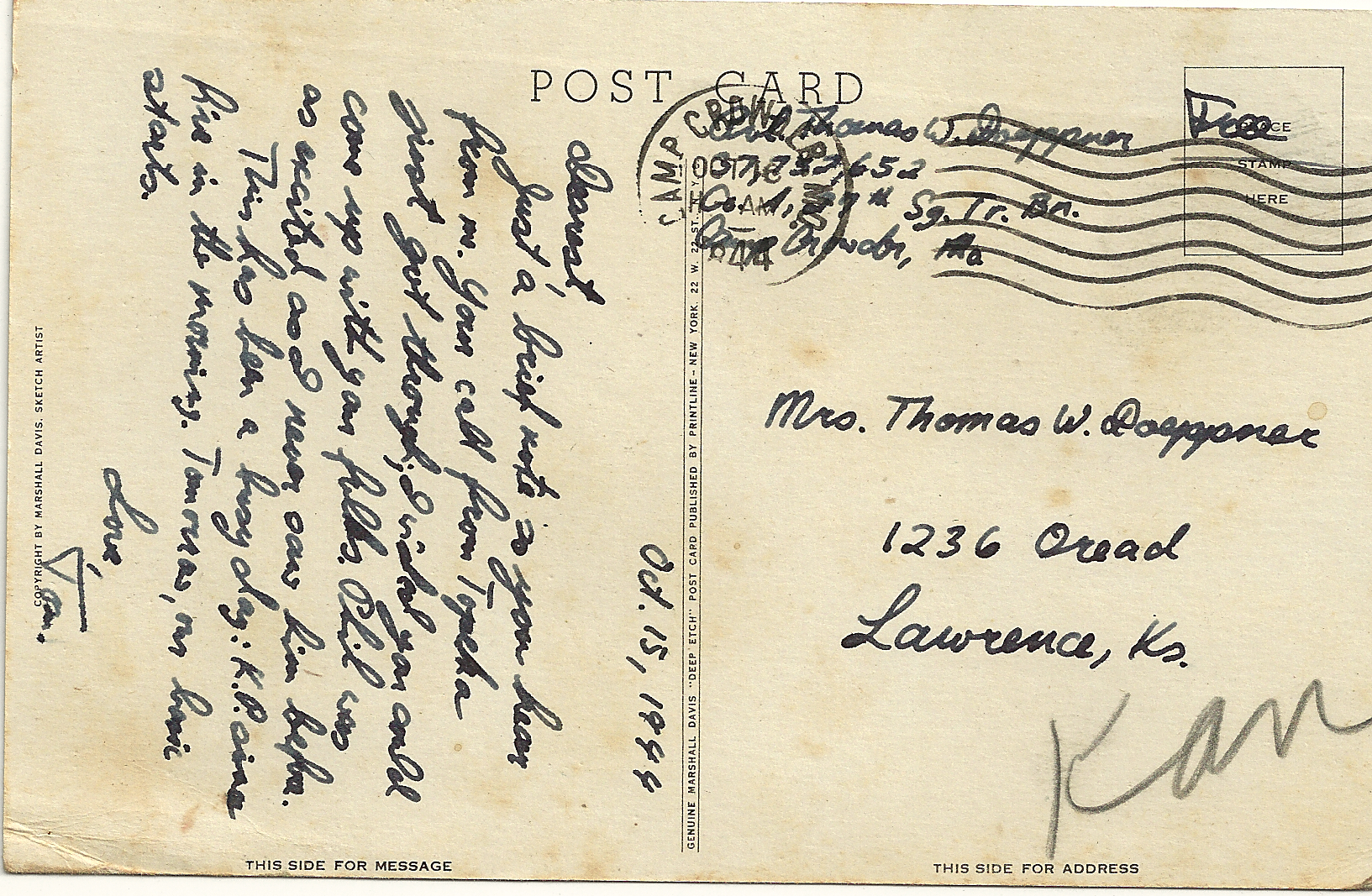
Postcard from Opa to Grandmother, October 15: 1944.


Transcription:

October 15, 1944

Dearest,

Just a brief note so you hear from me. Your call from Topeka just got through; I wished you could come up with your folks. Phil was as excited as I never saw him before.

This has been a busy day: K.P. since five in the morning. Tomorrow, our basic starts.

Love,

Tom.

This was a short note, sweet that he keeps writing every day. My takeaway: tomorrow basic starts. What?! What have they been doing this whole time? Is he just now going into basic training?? I'm so confused.

Thursday, September 15, 2022

October 14, 1944: POWs in Missouri


Letter from Opa to Grandmother, October 14, 1944

Transcription:

October 14, 1944

Darling,

This has been a long day, and I actually did do a little work. In the morning, we hauled some truck loads of gravel to the infiltration range. I had my hands bandaged in gloves and that way could work fairly well. In the afternoon, after some fooling around, I swang a paint brush. There were several prisoners of war working close to me, all Germans. It was a great temptation for me to speak to them. Although there is no law against it, I believe it would be an unwise thing to do so. I had fun listening to them, especially since they did not know that I understood what they said. When they started to sing some of the old familiar German songs, I must admit that a lump came into my throat.

Tonight,at 7pm, our company commander gave us a little orientation lecture. He is a young guy, about my age, lieutenant, with a Polish name: Tetkowski. Apparently, a swell guy. His talk was as unmilitary as he could possibly make it, and it showed that he was interested in the work for its own sake. I think I am going to like him. The only thing I didn't like was the fact that the lecture took till nine o'clock, which took away the best part of Saturday evening.

Tomorrow, Sunday, I'll have K.P. Apparently they think I need some practice in that kind of work. Well, someone has got to do it.

In the mail today, together with the enclosed letter from my friend in California, was one application blank (preliminary) for naturalization, which I received as an answer from the Kansas City Immigration Service. This deal is to be a long, drawn-out procedure, but I think there won't be much trouble.

Glad you went to the doctor. You should have expected that the doctor wouldn't have the diaphragm on stock; are you embarrassed to go to a drugstore for it?

I am tired and have to get up early for K.P. tomorrow, so I think I quit now. Tomorrow's letter may be rather brief too, for a similar reason.

Lots of love,
Tom.

P.S. Please return Gerd's letter.

This letter has a lot of nice little insights into Opa's life and the cultural milieu of the day. Grandmother is potentially embarrassed to buy birth control at the drugstore, and sadly I think we're still a little embarrassed about sex and birth control as a societal norm. It have a lot of opinions about this, but it isn't the point of this letter (or even my point about this letter), so I'l move on.

I am surprised that the naturalization process for Opa (and I suspect anyone) who has literally joined the United States military, is still so long and drawn-out. Opa knows it's worth it in the end, after all, this is the main reason why he joined. 

Opa doesn't talk much about his family or friends in Germany. My guess is that's because there is nothing new to talk about: no news is coming or going from the war-zone civilians in Europe. I suspect Opa easily avoids this topic as a method of self-preservation. I do this. If I know I can't do anything to help or change something, I cope by putting the whole situation in what I like to call a "black cloud." It's basically compartmentalizing, but I like to imagine a black-hole in space that has its opening just above my head in a dark cloud, perfect for when I need to throw something in and forget about it. 

I don't think Opa has forgotten his family and friends, absolutely not. In fact, his friend in California and Gerd (who I don't know but have a guess) are likely both Germany-related contacts. His whole endeavor to get citizenship is not only for his own survival, but so that he can sponsor his mother when everything is over. I don't think he has allowed himself the chance to entertain that she might not be able to come to the US. He faces what is in front of him, making choices based on the best case scenario and planning for the worst.

The part that intrigued me the most about this letter was the German POWs. I didn't realize that there were POWs on American soil. I suppose I should have known that, but like so many other things I have been ignorant about, I just never thought about it. I did some light searching and found this documentary about the POWs. 

Opa's response to them seems pretty natural: tempted to talk to them but deciding against it in the end. When he said that he had a lump in his throat when hearing the old folk songs of Germany, I got a little lump in mine. Nazis or not, Germany was still his home. The language, the stories, the songs, all of that was the backdrop of a childhood which was, for at least ten or so years, a good one. It's hard to compartmentalize when the black hole spits out a reminder of what you've tossed. Haven't you had that moment? When you catch the scent of something, the melody of a special song, even a familiar phrase or word? It catches you by surprise, evoking a response before you had a chance to shove it back into the abyss. 

I keep thinking about how war dehumanizes. We look back and think in terms of good vs evil, axis and allies, etc. In this weird conjunction of military troops and POWs from enemy territory, what is actually present is a group of humans, each with their own stories, songs, and black holes of memories. 

Opa is standing on the bridge between the two, wistful but moving on.